
-
Pdiam Info
- Wiki Knowledge
- 0 Comments
What Is NFC and Contactless Payments? How It Works, Benefits & Security (2026 Guide)
Direct Answer
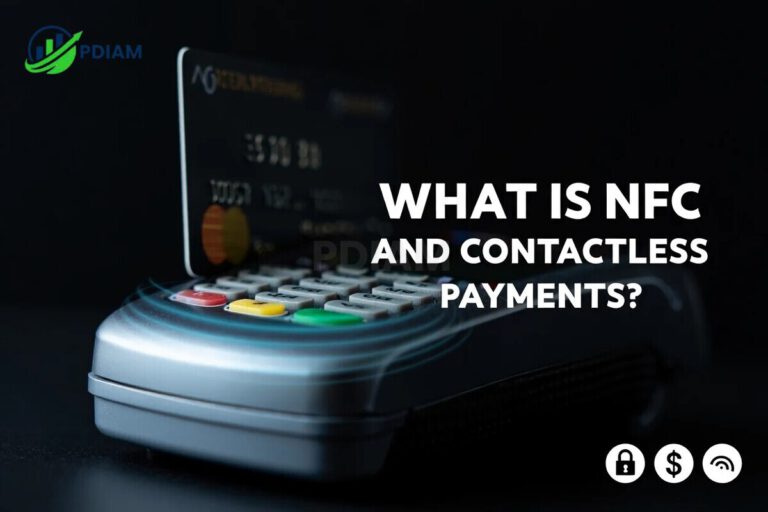
NFC (Near Field Communication) is a short-range wireless technology that allows two devices to exchange data when held within 4 cm of each other. Contactless payments use NFC to let you pay securely by simply tapping your smartphone, credit/debit card, or smartwatch on a payment terminal — without swiping or inserting anything.
1. What Is NFC and How Does It Relate to Contactless Payments?
NFC is the underlying technology. Contactless payments are the practical application of that technology at checkout. Think of NFC as the engine and contactless payments as the vehicle.
NFC enables secure, instant data exchange between your device and a payment terminal. This is what powers Apple Pay, Google Pay, Samsung Pay, and most modern contactless cards.
2. How NFC and Contactless Payments Work (Step-by-Step)
Every tap follows a fast and secure four-step process:
- Activation – Bring your phone, card, or watch within 4 cm of the NFC terminal.
- Data Transmission – Encrypted payment information is exchanged via radio waves.
- Authentication – The bank verifies a one-time token (not your real card number).
- Approval – The transaction completes in 1–2 seconds.
Pro Tip 2026: Most mobile wallets require biometric authentication (Face ID or fingerprint) before releasing payment data, adding an extra layer of protection.
3. Devices and Platforms That Support NFC Payments
- Smartphones: iPhone (Apple Pay), Samsung Galaxy (Samsung Pay), Google Pixel (Google Pay), and most Android devices.
- Smartwatches: Apple Watch, Samsung Galaxy Watch, Google Pixel Watch, Garmin, and Fitbit Pay.
- Contactless Cards: Most debit and credit cards issued after 2018 include built-in NFC chips.
- Point-of-Sale Terminals: Modern retail, restaurant, and transit terminals worldwide support tap-to-pay.
4. Real-World Applications and Global Adoption in 2026
NFC and contactless payments are now used in everyday scenarios:
- Retail & Grocery – Tap to pay for shopping in seconds.
- Public Transport – Tap-and-go in cities like London, New York, Singapore, and Seoul.
- Vending Machines & Events – Pay or gain entry with a simple tap.
- Restaurants & Cafes – Faster checkout and reduced cash handling.
Regional Adoption Trends (2026)
- Asia (China, South Korea): Over 70% adoption, heavily mobile-first.
- Europe: 60%+ adoption with strong coexistence of cards and digital wallets.
- North America: Rapid growth post-2020, now above 50% of in-store transactions.
- Emerging Markets: Around 40%, driven by affordable smartphones and digital wallets.
5. Are NFC and Contactless Payments Safe?
Yes — modern NFC payments are among the safest payment methods available. Here’s why:
- Tokenization: Your actual card number is never shared with the merchant.
- Encryption: Data is encrypted during transmission.
- Dynamic Codes: Each transaction uses a one-time code.
- Biometric Authentication: Fingerprint or Face ID required on mobile wallets.
Important Fact: NFC only works within 4 cm, making “skimming from a distance” extremely difficult.
6. Benefits of NFC and Contactless Payments
- Extremely fast checkout (1–2 seconds).
- More hygienic — minimal physical contact.
- Higher security through tokenization and biometrics.
- Convenient for travel and daily commuting.
- Reduces cash handling costs for merchants.
- Supports loyalty programs and digital receipts.
- Future-proof technology that continues to evolve.
7. Limitations and How to Overcome Them
- Some older terminals still don’t support NFC.
- Spending limits (often $50–$100) may require PIN for larger amounts.
- Requires battery power on phones and watches.
- International acceptance varies by card and region.
Pro Tip: Always carry a backup physical card when traveling, especially to areas with lower NFC adoption.
8. Frequently Asked Questions (FAQ)
Is contactless payment safe?
Yes. Tokenization, encryption, and biometric authentication make it safer than traditional card swiping in most cases.
What is the spending limit for contactless payments?
Most countries set a limit between $30–$100 before a PIN or signature is required. Limits vary by bank and region.
Can I use contactless payments without internet?
Some wallets support limited offline transactions, but full verification usually requires connectivity.
Does NFC work internationally?
Yes, in most developed countries. However, always check with your bank before traveling for best acceptance.
Written and updated April 2026 by Pdiam Knowledge Team. For the latest payment technology insights and practical business guides, visit Pdiam.